Custom-made full or partial dentures that restore your smile, chewing and speech, shaped and shaded for your face and fitted without surgery.
Removable teeth made to fit your mouth and suit your face, so you can eat, speak and smile with confidence again, without surgery.

 1000+ Google reviews

 Excellent on Trustpilot

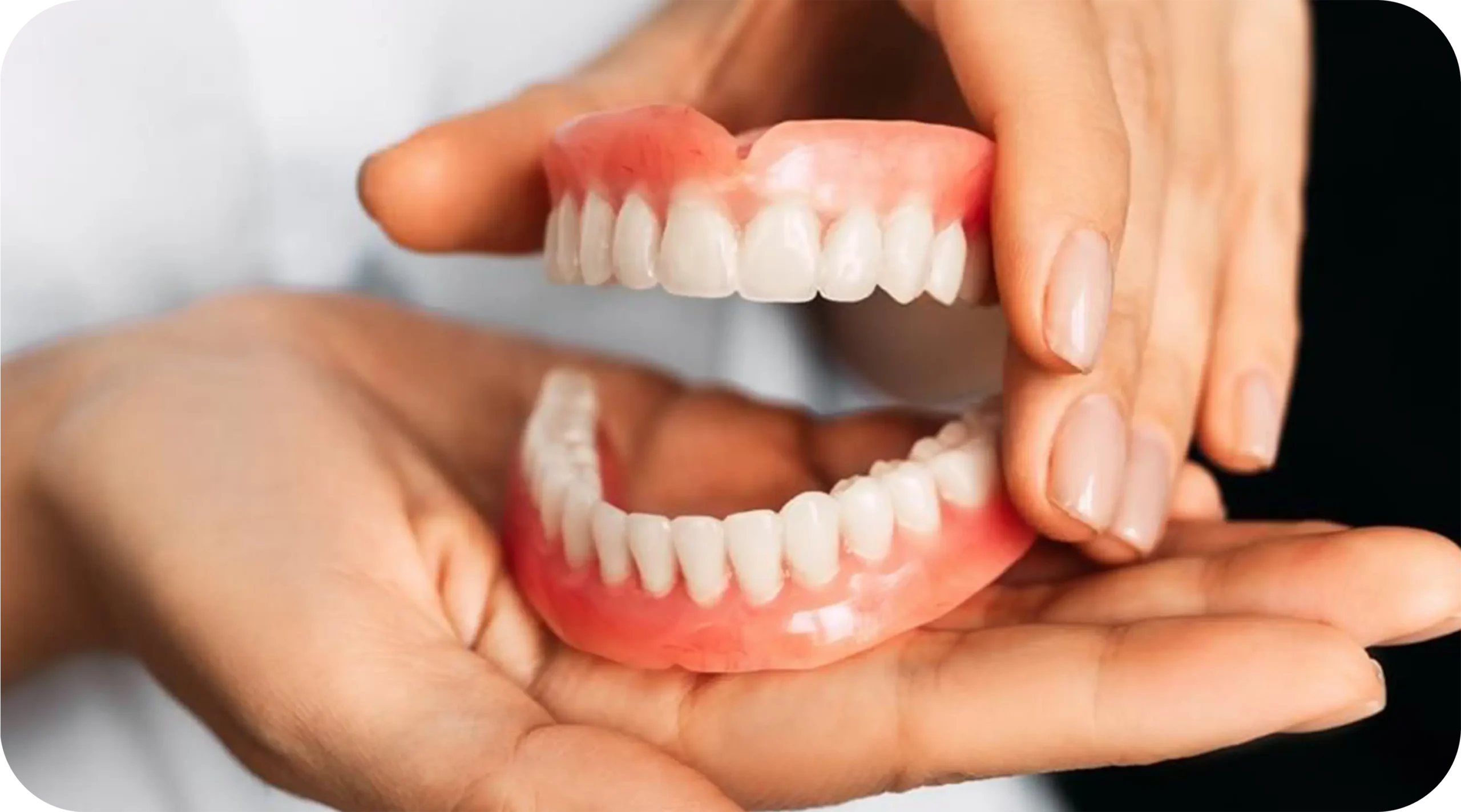
Dentures are custom-made removable teeth that replace some or all of your missing teeth without surgery.
They restore the ability to chew and speak clearly, support the lips and cheeks so the face does not look sunken, and give you a natural-looking smile. A full denture replaces all the teeth in one jaw. A partial denture fills the gaps between your remaining natural teeth and clips onto them for support.
Good dentures are not just rows of teeth. The shape, size and colour of the teeth are chosen to suit your face, your age and your skin tone. The position of the teeth affects how your lips sit, how full your cheeks look and how you pronounce certain sounds. That is why we take time over measurements and let you see the teeth in your mouth before the denture is finished.
A full denture sits on the gums and is held in place by suction and the shape of the jaw. Upper full dentures usually hold well because they cover the palate. Lower full dentures have less surface to grip and move more easily, which is something we discuss openly at the start.
A partial denture replaces one or several missing teeth and uses your remaining teeth for support. It can be made in rigid acrylic, or as a flexible denture that grips the natural teeth with gum-coloured clasps instead of visible metal. Before a partial denture is made, any decay or gum problems in the remaining teeth are treated, because the denture depends on them.
Dentures are the most affordable way to replace many missing teeth, and for many people they work very well. They are not for everyone. If a loose lower denture is already a problem, or you want teeth that stay fixed, an implant-supported solution may be the better investment. At HMC we place MegaGen implants as our primary system and Straumann as the alternative, and options such as All-on-4 and All-on-6 give you fixed teeth that never come out. Implants need 3 to 6 months of healing, so that route takes two stays rather than one.
We explain both paths clearly, including the trade-offs, and your written, itemised quotation shows exactly what each option involves.
Dentures in Albania are made at HMC in a few focused appointments: examination and measurements, a try-in so you can approve the look and bite, and the final fitting with adjustments. The measurements are sent to the laboratory at each stage, and nothing is finalised until you are happy with how the teeth look.
Dentures are made in stages, and each stage builds on the one before. Taking time here is what makes the difference between a denture that fits and one that rubs.
Your dentist examines your gums, any remaining teeth and the bone of the jaw, and takes any imaging needed. If remaining teeth need fillings, extractions or gum treatment, that is planned first. This is also where we discuss whether a full, partial or implant-supported option suits you best.
Detailed measurements of your gums and any remaining teeth are taken and sent to the laboratory. For full dentures, the measurements capture the shape of the ridges and the palate, which is what gives the denture its hold.
Next we record how your jaws relate to each other and how much space the teeth should fill. We choose the shape, size and shade of the teeth with you, looking at your face, your lips and any old photos you bring of your natural smile.
Before the denture is completed, the teeth are set up and tried in your mouth. You can see how they look when you smile and talk, and we check the bite. If you want the teeth longer, lighter or positioned differently, this is when it is changed.
The finished denture is fitted and checked for comfort, bite and any pressure points. Small adjustments are made before you leave, and we show you how to put the denture in, take it out and clean it. A flexible denture or partial denture is also checked for how securely it grips the natural teeth.
New dentures always feel strange at first. Speech may sound slightly different for a few days, and eating takes practice. Start with soft food cut into small pieces, chewing on both sides at once. Sore spots are common in the first days and are easy to adjust. Our team explains all of this in English, Italian, Spanish, French or Greek.
You See Your New Teeth Before They Are Finished. At the try-in appointment you see and feel the teeth in your mouth before the denture is completed. Shape, colour, length and bite can all be changed at this stage, so the finished denture looks and feels the way you agreed.
The right denture depends on how many teeth are missing, the health of your gums and what you want from your new teeth:
A durable, adjustable and affordable denture with a gum-coloured base, suitable for full and partial cases and easy to reline as gums change.
A lightweight partial denture that grips your natural teeth with gum-coloured clasps instead of visible metal, comfortable and discreet.
All-on-4 or All-on-6 on MegaGen or Straumann implants for teeth that never come out. Requires surgery and 3 to 6 months of healing.
Dentures are usually a good option if you:
If a loose denture is already your main problem, or you want teeth that never come out, ask us about implant-supported options such as All-on-4 or All-on-6. We explain both routes honestly before you decide.
Dentures are made over two to three appointments within a single stay, with each stage checked with you before the next begins:
We examine your gums, remaining teeth and jaw, take any imaging needed and agree the right type of denture with you.
Detailed measurements of your gums and teeth are taken and sent to the laboratory, where the base of your denture is shaped.
We record your bite and choose the shape, size and shade of the teeth with you, to suit your face.
You see and feel the teeth in your mouth before the denture is finished. Shape, colour and bite can still be changed.
The finished denture is fitted, checked for comfort and bite, and adjusted. We show you how to wear and clean it.
Your dentures are shaped around your face, not taken from a standard set. You see them before they are finished, the fit is checked carefully, and we tell you honestly when an implant-supported option would serve you better. Every stage is on your written, itemised quotation.
Explore our full range of treatments
Usually a few days, over two to three appointments: examination and measurements, a try-in, and the final fitting. If you need extractions, fillings or gum treatment first, that is scheduled before the denture. Your treatment plan gives you the exact schedule.
Yes. The shape, size and shade of the teeth are chosen to suit your face, and the gum-coloured base is made to look like real gums. At the try-in appointment you see the teeth in your mouth before the denture is finished, and we can change anything you are not happy with.
With practice, most people eat comfortably with dentures, but it takes a few weeks to adjust. Start with soft food cut into small pieces and chew on both sides at the same time. Very hard, sticky or chewy foods remain harder with dentures than with natural teeth. If eating is a priority, implant-supported teeth give a much stronger bite.
Speech may sound slightly different for the first few days while your tongue and lips get used to the denture. Reading aloud helps. Most people speak normally again within a week or two. If certain sounds remain difficult, the denture can be adjusted.
Lower full dentures have less surface to hold onto than upper dentures, and the tongue and cheeks move them more. This is a common complaint. A well-made denture helps, and a denture adhesive can add security. For lasting stability, implants are the most effective solution, holding the denture firmly in place.
A flexible denture is a type of partial denture made from a flexible material, such as Valplast. Instead of metal clasps, it grips your natural teeth with gum-coloured clasps, so it is more discreet. It is lightweight and comfortable, and suits many partial cases. Your dentist will tell you if it is right for your mouth.
It depends on your priorities, your jawbone and your budget. Dentures are non-surgical, quicker and more affordable. Implant-supported teeth, such as All-on-4 or All-on-6 on MegaGen or Straumann implants, are fixed, much more stable and help preserve the jawbone, but they involve surgery and 3 to 6 months of healing. We explain both options honestly and show both on your written quotation if you want to compare.
New dentures can cause sore spots in the first days as the gums adjust. These are common and easily fixed with small adjustments. A denture that keeps hurting after the first couple of weeks is not normal. Have it checked rather than putting up with it.
Take them out and brush them every day with a soft brush and denture cleaner. Avoid ordinary toothpaste, which can scratch the surface. Rinse them after meals. Keep them in water when they are out of your mouth, so they do not dry out. Clean your gums, tongue and any natural teeth as well.
We usually recommend taking them out at night. It gives your gums a chance to rest and helps prevent infections under the denture. Your dentist may advise differently in specific cases, for example in the first days after extractions.
Your written, itemised quotation lists the denture type, the number of appointments, and anything needed beforehand, such as extractions, fillings or imaging, each on its own line. If you want to compare dentures with an implant-supported option, both can be shown. Nothing is added once treatment starts that was not discussed with you first.
Send us a few details and our patient coordinators will come back within 24 hours with a treatment plan, timeline, and price. No obligation.