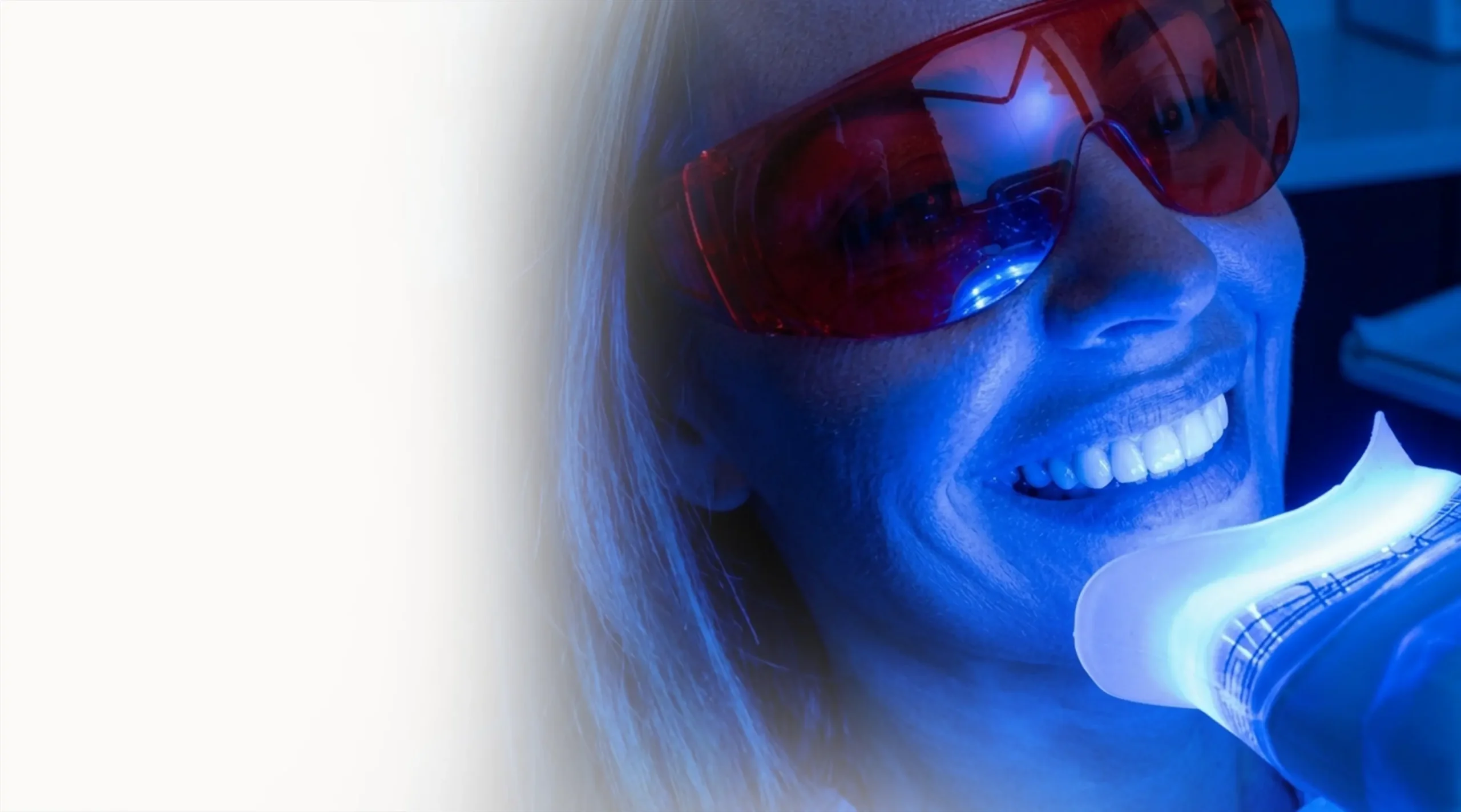
In-clinic whitening that lifts your teeth several shades in a single session, using enamel-safe gels with minimal sensitivity afterwards.
A brighter smile in a single appointment — professional-strength whitening, done safely under clinical supervision.

 1000+ Google reviews

 Excellent on Trustpilot
Teeth darken gradually enough that most people don't notice until they see a photograph. Coffee, tea, red wine, and tobacco leave pigment in the microscopic pores of enamel, and enamel itself thins with age, letting more of the yellower dentine beneath show through. Neither is a sign of poor hygiene — both are simply what happens over time.
Professional whitening reverses a good deal of that. Done by a dentist, with the right concentration and the gums properly protected, it's one of the most straightforward improvements in cosmetic dentistry: no drilling, nothing removed, nothing permanent.
At Health Medical Center in Tirana, whitening is completed in a single appointment, and we'll tell you honestly beforehand how much change to expect in your case.
This is the part most pages leave out, and it's the part worth reading.
Whitening works well on stains that sit in the enamel — coffee, tea, red wine, cola, tobacco — and on general age-related yellowing. These are the most common reasons people ask about whitening, and they typically respond well.
Whitening works less predictably on intrinsic discolouration: tetracycline banding, fluorosis, or a single tooth that darkened after trauma or root canal treatment. Some improvement is often possible, but the result is less dramatic, and for these cases veneers may be the better route. We'll say so at consultation rather than after.
Whitening does not work at all on crowns, veneers, composite bonding, or fillings. Ceramic and composite hold whatever shade they were made in. This has a direct consequence: if you have visible restorations, whitening your natural teeth will make them stand out, not blend in.
Restorations are matched to the shade of your teeth on the day they're made. If you whiten afterwards, your natural teeth lighten and the restorations stay exactly where they were — and the mismatch is permanent unless the restorations are remade.
So the correct order is: whiten first, let the shade settle, then match the restorations to your new brighter baseline. Getting this the wrong way round is one of the more expensive mistakes in cosmetic dentistry, and it's entirely avoidable with a conversation.
If you're travelling to us for veneers or crowns, tell us at the planning stage and we'll build whitening into the schedule ahead of the restorative work.
Most healthy adults are suitable. What matters is the condition underneath: whitening gel applied over untreated decay, exposed roots, or inflamed gums is uncomfortable and can make sensitivity worse. That's why the treatment starts with an examination rather than the gel.
Situations we plan around rather than refuse:
Whitening isn't recommended during pregnancy or breastfeeding, or for children whose teeth are still developing.
In-practice whitening is done here in a single appointment. The concentration is higher, your gums are professionally shielded, and you see the change the same day. This is the option most patients choose, particularly anyone travelling or working to a deadline.
Take-home whitening uses custom trays and a lower-concentration gel over a couple of weeks. It's more gradual, and useful for maintaining results or for people who find their teeth sensitive.
The two combine well: an in-practice session to do the work, trays to keep it there. We'll recommend based on your enamel, your sensitivity, and how quickly you need the result.
Shade assessment. We record your current shade against a standard guide and confirm whitening is suitable for your teeth and gums. This is also where we set a realistic expectation of how many shades you're likely to gain.
Protective preparation. Your gums and soft tissues are shielded so the gel only contacts enamel, then a professional-strength whitening gel is applied to the teeth.
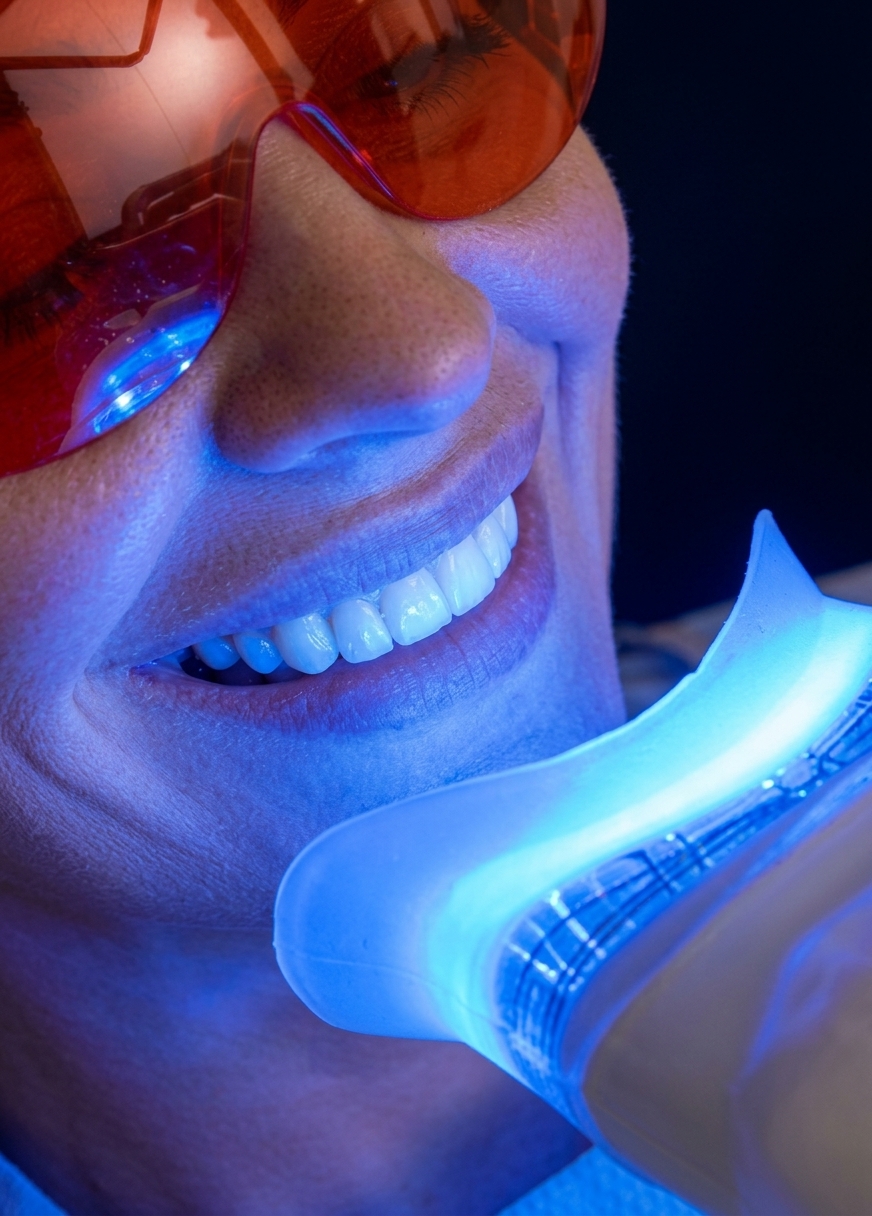
Activation. A single session with a specialised light, usually 20 to 30 minutes. Where sensitivity is a concern we shorten it — the aim is a comfortable result, not the longest possible application.
Shade check. We compare the result against your starting shade so you can see the change measured rather than guessed at.
Aftercare guidance. We talk you through how to protect the result before you leave — most importantly what to avoid over the first 48 hours, while enamel is most receptive to re-staining.
An honest assessment first. We tell you what your case will realistically achieve before you commit, including when whitening is the wrong treatment for the discolouration you have.
Dentist-supervised throughout. Gum protection, controlled concentrations, and monitoring between cycles — the things that separate professional whitening from a shop-bought kit.
Sequenced correctly with other treatment. If veneers or crowns are in your plan, whitening is scheduled before them, not after.
Support in your language. Our team works in English, Italian, Spanish, French, and Greek.
Aftercare. We talk you through how to look after the result before you leave, and a direct contact number stays open to you afterwards — if anything comes up once you're home, you can reach us.
Plenty of patients plan a short trip around exactly this: a hygiene appointment and a whitening session, done properly, for less than whitening alone costs at home. Both fit comfortably into a couple of days, which leaves the rest of the weekend to you.
The two also work best in that order. Professional cleaning removes surface staining and calculus first, so the whitening gel acts on clean enamel — the result is brighter and more even than whitening over a film of plaque.
Tirana International Airport takes direct flights from Milan, Rome, Bologna, Venice, London, Dublin, Madrid, Barcelona, Paris, Athens, and much of Central Europe, typically 1.5 to 2.5 hours. EU, UK, and US citizens travel without a visa.
If veneers, crowns, or implants are also in your plan, whitening is simply scheduled ahead of the restorative work — see the sequencing note above.
Between six months and three years, depending almost entirely on habits. Coffee, tea, red wine, and tobacco are what bring the shade back down; how much of them you have, and whether you rinse afterwards, matters more than anything we do in the chair.
Regular hygiene appointments help considerably, since surface staining is removed before it settles. Many patients keep a take-home kit for occasional top-ups, which is far less involved than repeating the full treatment.
The first 48 hours matter most. Enamel is temporarily more porous after whitening, so a light-coloured diet for two days protects the result you've just paid for.
Professional teeth whitening uses a higher concentration of whitening gel than over-the-counter products, applied under controlled clinical supervision. Before any gel is applied, we check your current shade and confirm whitening is suitable for your teeth and gums.
Your gums are then shielded to protect them, and a professional-strength whitening gel is applied to your teeth, often assisted by a specialised light, in short cycles. This combination of higher-strength gel and clinical protection is what allows whitening to work faster and more predictably than at-home kits, often within a single appointment.
Whitening Only Works on Natural Teeth. Whitening gel doesn't change the colour of crowns, veneers, or fillings. If you have visible restorations at the front of your mouth, let us know before your appointment so we can plan around them.
Both use the same professional-grade gel - the difference is where it happens:
A higher-concentration gel applied under clinical supervision, with visible results in a single session.
Custom-fitted trays and professional-grade gel for gradual whitening over one to two weeks, at home.
Professional whitening is worth considering if you:
Whitening doesn't work on crowns, veneers, or fillings - if you have visible restorations at the front of your mouth, we'll talk through matching them once your natural teeth reach their new shade.
Whitening is completed in a single appointment, from shade check to final result:
We record your current shade against a standard guide and confirm whitening is suitable for your teeth and gums. This is also where we set a realistic expectation of how much change to expect.
Your gums and soft tissues are shielded so the gel only contacts enamel, then a professional-strength whitening gel is applied to the teeth.
A single session with a specialised light, usually 20 to 30 minutes. Where sensitivity is a concern we shorten it — the aim is a comfortable result, not the longest possible application.
We compare the result against your starting shade, so you can see the change measured against the guide rather than guessed at.
We talk you through how to protect the result before you leave — most importantly what to avoid over the first 48 hours, while enamel is most receptive to re-staining.
Your current shade and gum health are checked before any gel is applied, so whitening only goes ahead once we've confirmed it's genuinely suitable for your teeth.
Explore our full range of treatments
No. Professional whitening gels lift pigment from within the enamel without removing tooth structure. The risk with unsupervised products isn't the whitening itself but uncontrolled concentrations and unprotected gums.
Some patients notice mild sensitivity for a day or two afterwards. It's temporary. If your teeth are already sensitive, tell us beforehand and we'll adjust the protocol.
Most patients gain several shades. The realistic ceiling depends on your starting shade and the type of discolouration, which is why we assess before treating rather than promising a number. We also aim for a result that looks natural against your complexion.
No. Ceramic and composite keep the shade they were made in. If you have visible restorations, we'll discuss how to get the whole smile matching — usually by whitening first and replacing or adjusting restorations afterwards.
You can, but avoid strongly coloured food and drink for the first 48 hours — coffee, tea, red wine, berries, tomato sauce, and tobacco. Water is fine throughout.
Most people top up every six to twelve months. We'll advise based on how your shade holds.
For most patients, yes. Where the starting shade is particularly dark, a second session may be recommended to reach the target.
We'll go through the aftercare with you before you leave, and you'll have a contact number that stays available to you. If anything comes up once you're home, call us and we'll advise you directly.
4.9
/ 1006 reviews
“I had composite bonding, a clean, and whitening done, and my experience was genuinely excellent from start to finish. I'm really happy with my teeth - they are beautiful! I would 100% recommend them.”
“I've had a lovely experience at HMC. Went for cleaning and whitening. The clinic is very clean and the staff are very polite and friendly.”
Send us a few details and our patient coordinators will come back within 24 hours with a treatment plan, timeline, and price. No obligation.